 MortgageCalc
Strategic Arbitrage in VA Loan Assumptions: Entitlement Substitutions, Servicer Guidelines, and Liability Mitigation
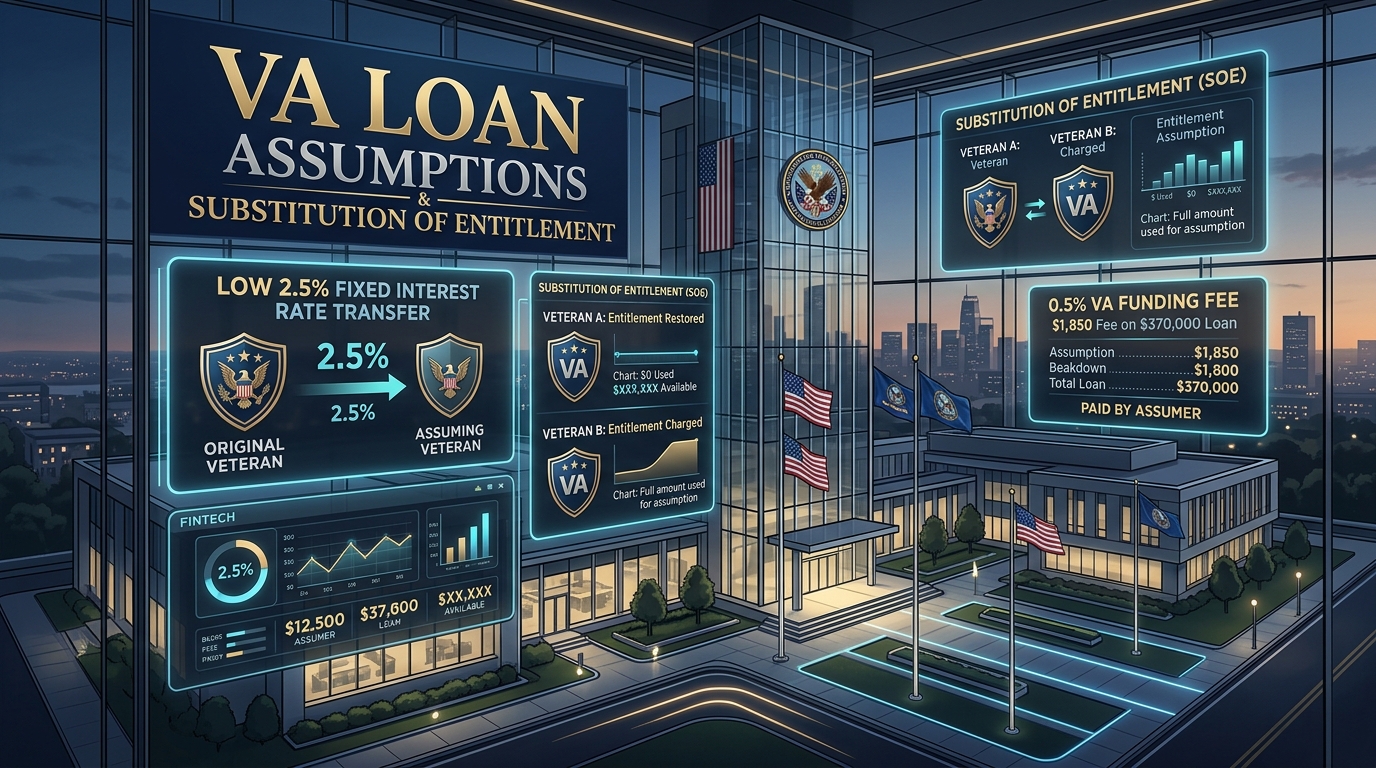
Department of Veterans Affairs (VA) home loans are assumable by design under federal statute (38 U.S.C. § 3714), allowing both military veterans and non-military civilians to assume a seller's existing VA mortgage while inheriting the original low interest rate (often 2.25% to 3.50%) and remaining amortization schedule.
However, when a civilian or non-eligible buyer assumes a VA mortgage, the original veteran seller's federal guaranty Entitlement remains permanently locked in the property until the loan is paid off in full. To preserve and restore the seller's zero-down purchasing power, the transaction must be structured as a Substitution of Entitlement (SOE) with an eligible veteran buyer, accompanied by a formal Release of Liability (ROL) executed by the loan servicer and the VA.
Why VA Assumptions Are the Premier Hedge Against High Mortgage Rates
With current market origination rates for 30-year mortgages fluctuating above 6.50%, the secondary market for assumable VA loans has surged into a multi-billion-dollar arbitrage sector. Because VA loans originated during the historic monetary easing of 2020–2022 feature interest rates well below current inflation metrics, assuming an existing VA note delivers life-changing financial leverage.
Concrete Interest Savings Breakdown on a $450,000 Balance
If a home buyer takes over an existing $450,000 VA mortgage balance at 2.75% fixed rather than taking out a new mortgage at 6.50% fixed:
- Monthly Principal & Interest (Assumed at 2.75%): $1,837 / month
- Monthly Principal & Interest (New Origination at 6.50%): $2,844 / month
- Net Monthly Savings: $1,007 per month ($12,084 annually)
- 30-Year Interest Savings: Over $362,000 in total interest saved across the life of the loan.
The Entitlement Trap: Veteran vs. Civilian Buyer Structuring
While federal law explicitly states that you do not have to be a military veteran to assume a VA loan, the treatment of the seller's VA Entitlement creates a stark operational divide between veteran and civilian assuming buyers.
Every veteran receives a baseline and bonus entitlement from the Department of Veterans Affairs that backs 25% of the loan amount, enabling 0% down financing without private mortgage insurance (PMI). When an assumption occurs, the underwriter must resolve whose entitlement secures the loan going forward:
| VA Assumption Parameter | Veteran Buyer with Entitlement (SOE) | Civilian Buyer (Non-Veteran / No Entitlement) |
|---|---|---|
| Seller's VA Entitlement Status | 100% Restored to Veteran Seller | Locked & Trapped on the Property |
| Buyer's Entitlement Impact | Buyer substitutes their own entitlement | N/A (Civilians have no entitlement) |
| Seller's Ability to Buy Another Home at 0% Down | Fully Unrestricted across all price tiers | Severely Restricted (Limited to remaining bonus entitlement) |
| VA Statutory Funding Fee | 0.50% of Assumed Principal Balance | 0.50% of Assumed Principal Balance |
| Servicer Processing & Underwriting Fee | Max $300 (Automatic) / $250 (Prior Approval) | Max $300 (Automatic) / $250 (Prior Approval) |
| Release of Liability (ROL) Issued | Yes (Formally Executed at Closing) | Yes (Formally Executed at Closing) |
What Happens When a Civilian Assumes a VA Loan?
If a civilian assumes your $400,000 VA loan, your $100,000 entitlement guaranty ($400k × 25%) remains tied to that specific home.
- The Consequence: If you subsequently apply to buy your next primary residence using your VA benefit, your available entitlement is reduced. Unless you have sufficient "bonus entitlement" remaining under local county loan limits, you will be forced to make a significant cash down payment on your next home or utilize conventional financing.
How Substitution of Entitlement (SOE) Works
To prevent trapping the seller's benefit, the transaction should be structured with another eligible veteran who possesses sufficient entitlement. At closing, the buyer signs a Request for Substitution of Entitlement (VA Form 26-6381). The VA formally transfers the guaranty charge to the buyer's Certificate of Eligibility (COE) and issues a full restoration of entitlement to the seller.
Underwriting Criteria: Servicer Guidelines & Credit Verification
Regardless of whether the buyer is a veteran or civilian, every post-March 1, 1988 VA loan assumption requires full underwriting approval by the current mortgage servicer in accordance with VA Lender's Handbook Chapter 5 Section 3.
1. Credit Score Standards
- Typical Servicer Requirement: A minimum credit score between 620 and 640 FICO.
- Clean Payment History: Zero late payments on the subject mortgage over the past 12 months, and no major unaddressed collections or active bankruptcies.
2. Debt-to-Income (DTI) & Residual Income Math
The servicer evaluates the buyer's qualifying gross income against the assumed mortgage's monthly PITIA plus all recurring revolving and installment debt.
- Standard DTI Cap: Generally capped at 41% DTI.
- VA Residual Income Test: If the buyer's DTI exceeds 41%, the servicer must calculate the buyer's Residual Income (net cash remaining after paying housing, taxes, and debt). If the buyer's residual income exceeds VA regional guidelines by at least 20%, the assumption can be approved with a DTI up to 50%+.
3. The Statutory 0.50% VA Funding Fee
Unlike forward VA purchases where the funding fee ranges from 1.25% to 3.30%, the statutory funding fee for an assumption is a flat 0.50% of the assumed unpaid principal balance.
Example: $380,000 Balance × 0.005 = $1,900
Exemptions: If the assuming veteran has a service-connected disability rating of 10% or higher from the VA, the 0.50% funding fee is entirely waived ($0).
Are you a veteran selling your home or a buyer attempting to assume a sub-3% VA mortgage? Servicer assumption desks often drag out processing for months due to improper entitlement substitution documentation. Let our specialized VA underwriting team review your COE, calculate your cash equity gap, and expedite your Release of Liability packet.
Open Mortgage Calculator →The Release of Liability (ROL): Protecting the Veteran Seller
Executing a VA assumption without obtaining a formal, written Release of Liability (ROL) under 38 U.S.C. § 3713 is the most catastrophic mistake a veteran seller can make.
If the servicer does not issue an official ROL and the assuming buyer defaults on the mortgage two years later:
- The Foreclosure Hits Your Credit: The mortgage servicer reports the foreclosure directly onto the original veteran seller's credit report.
- Federal Debt Collection & Indemnity: The VA pays the guaranty claim to the lender and immediately opens a federal debt collection action against the original veteran seller to recoup the government's loss, garnishing tax refunds and federal wages.
How to Guarantee Your ROL is Issued
To ensure full legal discharge, the seller must verify that the assumption agreement explicitly states that the buyer assumes all contractual liabilities of the promissory note and deed of trust, and the servicer must issue formal written confirmation that the veteran is released from all liability to the lender and the United States Government prior to escrow disbursement.
Common Pitfalls & Mistakes to Avoid
- Letting the Buyer Pay the Equity Gap with Unverified Funds: When the purchase price exceeds the assumed loan balance, the buyer must pay the Equity Gap in cash or secondary financing. Underwriters require full asset verification and 60-day bank statement seasoning for the equity gap funds. Unverified cash deposits or undisclosed personal loans will trigger an immediate underwriting freeze.
- Assuming Civilians Can Substitute Entitlement: A civilian buyer (or a veteran who has exhausted their entitlement on another property) cannot execute a Substitution of Entitlement. If you are a veteran seller who plans to purchase another home immediately using your 0% down VA benefit, you must make your listing explicitly contingent upon the buyer being an eligible veteran willing to substitute entitlement.
- Ignoring Servicer Automatic vs. Prior Approval Status: Most major lenders have "Automatic Authority" from the VA to approve assumptions internally. However, if the lender lacks automatic authority or if the loan is in default, the entire file must be mailed directly to the VA Regional Loan Center (RLC) for "Prior Approval," adding 30 to 45 days to the transaction timeline.
Practical Tips for Buyers and Sellers
- Leverage VA Circular 26-23-10 Servicer Timelines: In response to extensive processing delays across retail bank assumption departments, the VA issued Circular 26-23-10, formally mandating that servicers must process, underwrite, and render a final decision on a complete assumption application within 45 calendar days. Quote this directive to your assumption processor to maintain accountability.
- Combine a VA Assumption with a VA Second Mortgage or HELOC: If the cash equity gap is larger than the buyer's liquid savings (e.g., $150,000 equity gap), the buyer can utilize a subordinate institutional HELOC or second mortgage to cover the difference, provided the combined loan-to-value (CLTV) and residual income metrics pass underwriting criteria.
- Order the Certificate of Eligibility (COE) on Day One: If executing a veteran-to-veteran Substitution of Entitlement, have the assuming buyer pull their official COE via the VA eBenefits portal on the exact day the purchase contract is signed to confirm their exact available entitlement figure before opening escrow.
Frequently Asked Questions (FAQ)
Authoritative Sources & Regulatory References
- VA Lender's Handbook (HUD/VA Pamphlet 26-7) Chapter 5 Section 3: Assumptions & Release of Liability
- United States Code: 38 U.S.C. § 3714 - Assumptions; Release of Liability
- VA Circular 26-23-10: Processing Assumptions and Timelines for VA-Guaranteed Home Loans
- VA Form 26-6381: Application for Assumption Approval and/or Release from Personal Liability
- Veterans United Economic & Legal Reference: VA Loan Assumption Guide for Buyers and Sellers
- NewDay USA Military Lending Analysis: What is a VA Loan Assumption?
- The Federal Savings Bank Research: Veterans Affairs Loan Assumption Mechanics