 MortgageCalc
Navigating the 2026 Conforming Loan Limit Escalation in Conventional and Jumbo Credit Markets
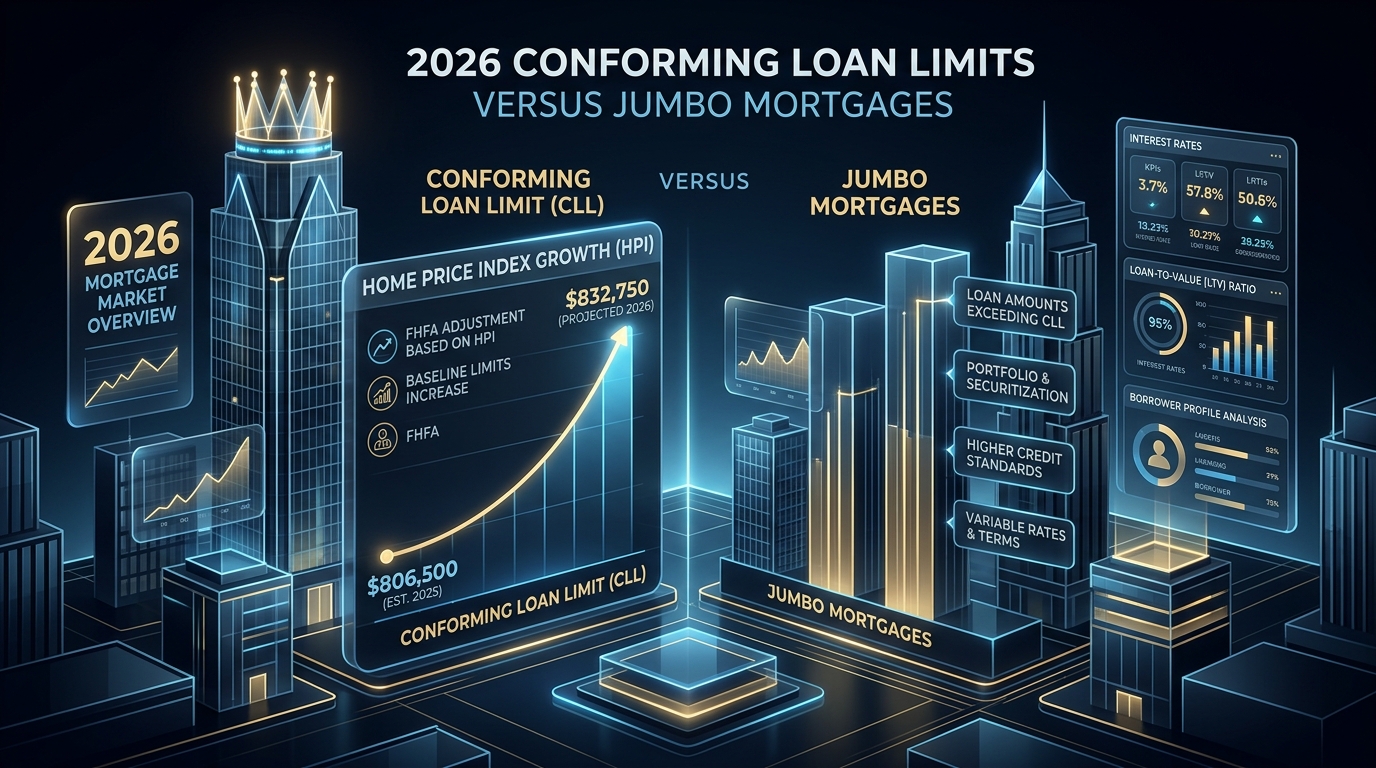
For calendar year 2026, the Federal Housing Finance Agency (FHFA) has officially raised the baseline national conforming loan limit (CLL) for a one-unit residential property to $832,750—an increase of $26,250 over the 2025 baseline of $806,500.
In designated high-cost metropolitan statistical areas (MSAs) where 115% of the local median home value exceeds the national baseline, the statutory ceiling rises to 150% of the baseline, capping one-unit conforming mortgages at $1,249,125. For statutory exception territories including Alaska, Hawaii, Guam, and the U.S. Virgin Islands, the baseline starts at the high-cost ceiling of $1,249,125 and reaches up to $1,873,687. This structural escalation allows borrowers to finance higher-value homes under GSE (Fannie Mae and Freddie Mac) guidelines, unlocking lower interest rates, reduced capital reserve requirements, and more favorable underwriting terms compared to non-conforming jumbo mortgages.
Why the 2026 Conforming Loan Limit Escalates: The Statutory HERA Math
The primary residential mortgage market in the United States operates under a bifurcated structure: Conforming Mortgages (loans eligible for purchase and securitization by Government-Sponsored Enterprises, or GSEs) and Non-Conforming / Jumbo Mortgages (balance-sheet loans held in private bank portfolios or private label securitizations).
Under the statutory mandate of the Housing and Economic Recovery Act of 2008 (HERA), the FHFA is legally required to adjust the conforming loan limit annually to reflect changes in national average home prices. The adjustment is driven by the expanded-data FHFA House Price Index (HPI), measuring home price appreciation between the third quarter of the previous year and the third quarter of the current year.
The Statutory Baseline Calculation Formula
Between Q3 2024 and Q3 2025, the expanded-data FHFA HPI recorded a national home price appreciation (ΔHPI) of exactly 3.26% (0.0326).
High-Cost Area Ceiling (150% Cap): $832,750 × 1.50 = $1,249,125
2026 Statutory Conforming Loan Limit Matrix by Property Type
Whether you are purchasing a single-family primary residence or house-hacking a fourplex, the conforming envelope scales dramatically with unit count. Below is the complete statutory breakdown for 2026 across all property sizes:
| Property Unit Size | 2025 Baseline Limit | 2026 Baseline Limit | 2025 High-Cost Ceiling | 2026 High-Cost Ceiling | Special Exception Areas (AK, HI, GU, VI) |
|---|---|---|---|---|---|
| 1-Unit (SFR / Condo) | $806,500 | $832,750 | $1,209,750 | $1,249,125 | $1,873,687 |
| 2-Unit (Duplex) | $1,032,650 | $1,066,250 | $1,548,975 | $1,599,375 | $2,399,050 |
| 3-Unit (Triplex) | $1,248,150 | $1,288,800 | $1,872,225 | $1,933,200 | $2,899,800 |
| 4-Unit (Fourplex) | $1,551,250 | $1,601,750 | $2,326,875 | $2,402,625 | $3,603,925 |
The Interest Rate & Underwriting Spread: Conforming vs. Jumbo Mortgages
When loan amounts cross the conforming threshold into jumbo territory, the underwriting dynamics change significantly. Because jumbo loans cannot be sold to Fannie Mae or Freddie Mac, commercial banks and portfolio lenders must hold them on their balance sheets, requiring higher capital allocations under Basel III liquidity frameworks.
During late 2025 and entering 2026, market data revealed a consistent 21-basis-point (0.21%) spread between 30-year fixed conforming loans (averaging 6.21%) and 30-year fixed jumbo mortgages (averaging 6.42%). On an $830,000 mortgage, transitioning from a jumbo loan at 6.42% to a conforming loan at 6.21% saves a borrower approximately $1,350 per year in interest while eliminating strict portfolio overlays.
| Underwriting Parameter | Standard Conforming (Fannie/Freddie) | Non-Conforming Jumbo (Portfolio) | Borrower Advantage of Conforming Status |
|---|---|---|---|
| Average Interest Rate (30-Yr Fixed) | 6.21% | 6.42% (+21 bps spread) | Lower monthly interest payments and lifetime borrowing cost. |
| Minimum Down Payment (LTV) | 3% to 5% Down (95%–97% LTV) | 10% to 20% Down (80%–90% LTV) | Far greater upfront liquidity preservation. |
| Minimum Credit Score Floor | 620 FICO (Standard AUS) | 680 to 720 FICO (Portfolio Overlays) | Accessible to broader borrower credit profiles. |
| Post-Closing Cash Reserves | 0 to 2 Months PITIA | 6 to 12 Months PITIA | Prevents tying up tens of thousands in liquid cash. |
| Debt-to-Income (DTI) Cap | Up to 50% DTI (with strong AUS) | Strictly capped at 43% to 45% DTI | Higher qualifying borrowing power. |
Are you purchasing a home near the $832,750 baseline or the $1,249,125 high-cost ceiling? Don't get pushed into a higher-rate jumbo mortgage due to outdated county lookups. Use our dynamic calculator to test your monthly PITI payments against live property tax rates and insurance estimates.
Open Mortgage Calculator →Strategic Borrower Tactics: Capitalizing on the 2026 Limit Escalation
For homebuyers and homeowners whose existing or target loan amounts fall between the old 2025 limit ($806,500) and the new 2026 limit ($832,750), several arbitrage opportunities exist:
1. The "Early Capture" Portfolio Transition
Private depository banks and non-bank lenders regularly adjust their internal origination guidelines ahead of the formal January 1 statutory date. In October and November 2025, proactive lenders began underwriting loans up to $832,750 as conforming loans on their internal books, holding them temporarily until Fannie Mae and Freddie Mac opened their acquisition windows for 2026 deliveries.
2. Strategic Jumbo-to-Conforming Refinancing
If you originated a jumbo mortgage in 2024 or 2025 with a principal balance between $806,500 and $832,750 (or up to $1,249,125 in high-cost counties), your loan is now officially GSE-conforming. Refinancing out of your private jumbo loan into a 2026 conforming fixed-rate mortgage allows you to drop your interest rate, eliminate jumbo reserve requirements, and remove portfolio restrictions.
3. Combining Conforming Subordinate Financing (Piggyback Loans)
If your target purchase price requires a loan slightly above $832,750, you can structure an 80-10-10 or 80-15-5 Piggyback Loan. By keeping your first mortgage exactly at the $832,750 conforming limit and financing the remainder with a simultaneous Home Equity Line of Credit (HELOC) or second mortgage, you preserve conforming interest rates on the primary balance and bypass jumbo underwriting entirely.
Common Pitfalls & Mistakes to Avoid
- Relying on State-Level Summaries Instead of County Lookups: Conforming loan limits are assigned at the County or Metropolitan Statistical Area (MSA) level, not by state. A home in Santa Clara County, California qualifies for the full $1,249,125 high-cost ceiling, while a home just a few counties over in Fresno County is capped at the $832,750 baseline. Always verify the exact FIPS county code before structuring your purchase contract.
- Confusing Conforming Limits with FHA or VA Limits: While FHA forward limits are mathematically linked to conforming limits (pegged between 65% and 150% of the baseline), VA loans have no statutory loan limit for veterans with full entitlement. Do not apply conventional conforming caps to VA borrowers.
- Miscalculating Multi-Family Rental Income Qualifying: When utilizing the higher 4-unit conforming limit ($1,601,750) to purchase a residential multi-family property, underwriters will only credit 75% of the gross rental income toward your DTI to account for vacancy and maintenance. Ensure your debt-to-income math aligns with GSE underwriting standards before waiving financing contingencies.
Frequently Asked Questions (FAQ)
Authoritative Sources & Regulatory References
- Federal Housing Finance Agency (FHFA) Announcement on 2026 Conforming Loan Limit Values
- Housing and Economic Recovery Act of 2008 (HERA) Statutory Framework
- Fannie Mae Selling Guide Section B2-1.5-01: Loan Limits & Underwriting Directives
- Freddie Mac Single-Family Bulletin & Loan Limit Values for 2026
- Consumer Financial Protection Bureau (CFPB) Truth in Lending Act & QM Standards
- Ameris Bank December Mortgage Monitor & Rate Spread Analysis
- The Federal Savings Bank Research: Understanding 2026 Conforming Loan Limits