 MortgageCalc
Leveraging FHA Multi-Family Forward Limits in 2026: An Investment Guide for Owner-Occupied Properties
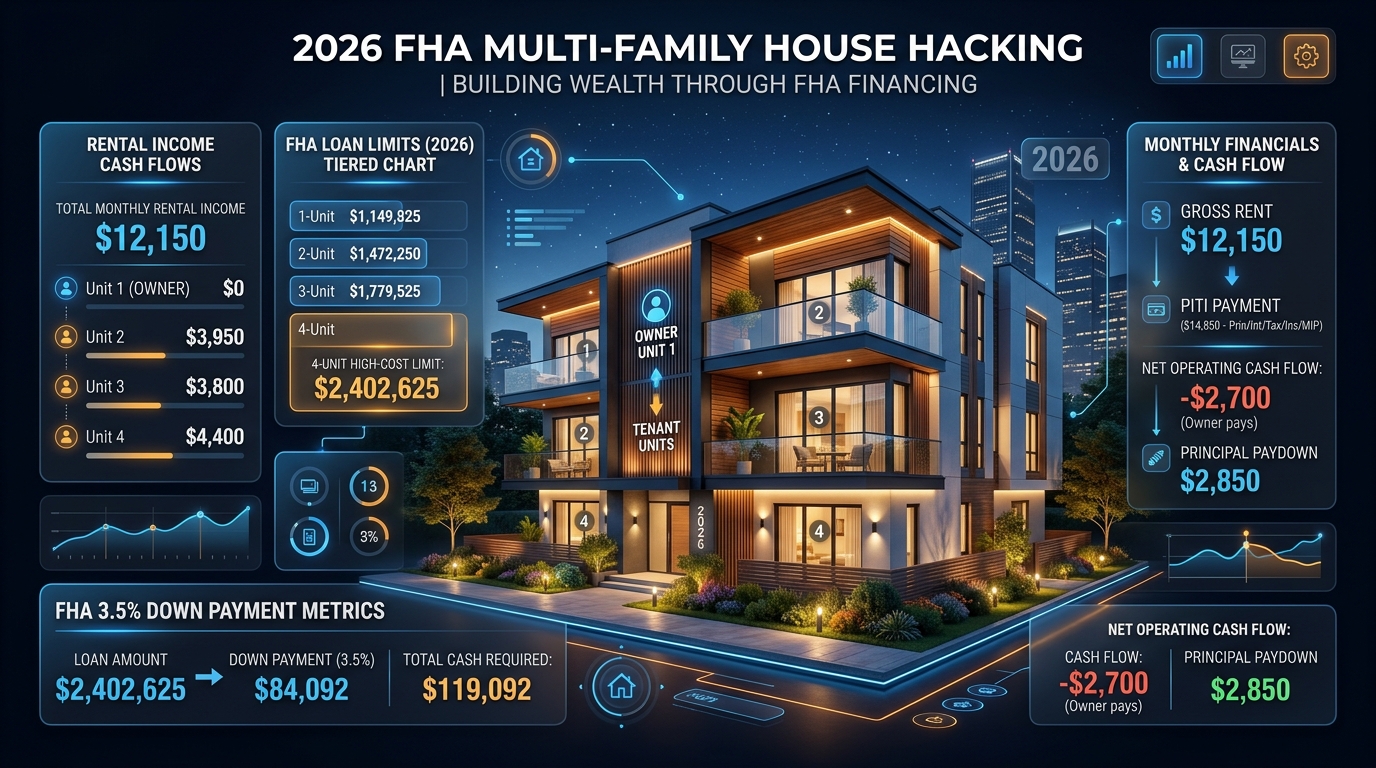
Under Department of Housing and Urban Development (HUD) Mortgagee Letter 2025-23, the 2026 FHA forward mortgage loan limits for multi-family residential properties have escalated up to $1,041,125 in standard low-cost counties and reach an astounding ceiling of $2,402,625 in designated high-cost metropolitan areas for 4-unit (fourplex) properties.
Because FHA statutory borrowing limits are legally pegged between 65% (the floor) and 150% (the ceiling) of the national baseline conforming loan limit ($832,750), the upward trajectory of national housing appreciation has dramatically expanded FHA borrowing power. This allows real estate investors and move-up buyers to execute high-value House Hacking strategies—acquiring 2–4 unit residential income properties with just 3.5% down while utilizing the rental revenue from tenant units to qualify under standard FHA Debt-to-Income (DTI) thresholds.
Why FHA Multi-Family Limits Move in Tandem with Conforming Baselines
Under the statutory framework of the National Housing Act (Section 203(b)), the FHA does not arbitrarily set its maximum mortgage limits. Instead, HUD calculates its local county ceilings using a formula directly tied to the Federal Housing Finance Agency (FHFA) national conforming baseline.
The Statutory Floor Formula (Low-Cost Counties)
In any U.S. county where 115% of the local median home price falls below $541,287, the FHA sets the statutory 1-unit floor exactly at $541,287.
The High-Cost MSA Ceiling Formula (150% Cap)
For expensive coastal markets (such as Los Angeles, New York City, Seattle, and Boston), the single-family FHA ceiling locks in at $1,249,125. However, when purchasing multi-unit properties (2, 3, or 4 units), the statutory envelope scales exponentially.
2026 FHA Multi-Family Forward Mortgage Loan Limit Matrix
Below is the complete official HUD forward mortgage limit breakdown for calendar year 2026 across low-cost floors, high-cost ceilings, and non-contiguous special exception areas (Alaska, Hawaii, Guam, and the U.S. Virgin Islands):
| Property Unit Size | Low-Cost Area Floor (Standard Counties) | High-Cost Area Ceiling (Metro MSAs) | Statutory Exception Areas (AK, HI, GU, VI) | Minimum Down Payment |
|---|---|---|---|---|
| 1-Unit (Single Family / Condo) | $541,287 | $1,249,125 | $1,873,687 | 3.5% Down |
| 2-Unit (Duplex) | $693,050 | $1,599,375 | $2,399,050 | 3.5% Down |
| 3-Unit (Triplex) | $837,700 | $1,933,200 | $2,899,800 | 3.5% Down |
| 4-Unit (Fourplex) | $1,041,125 | $2,402,625 | $3,603,925 | 3.5% Down |
The Power of 3.5% Leverage on a $2.4 Million Asset
To understand why FHA multi-family financing is the premier residential real estate wealth-building tool, examine the upfront capital required for a 4-unit fourplex at the high-cost ceiling:
- Purchase Price / Total Valuation: $2,400,000
- FHA 3.5% Down Payment Required: $84,000
- Conventional Investment Loan Down Payment (25% Required): $600,000
By occupying one unit as your primary residence for a minimum of 12 months, the FHA allows you to control a $2.4 million cash-flowing building with $516,000 less upfront cash than a commercial investor.
What is House Hacking? Deconstructing the 75% Rental Income Formula
House hacking is an investment strategy where a homebuyer purchases a multi-family property (duplex, triplex, or fourplex), lives in one unit as their primary residence, and rents out the remaining units to tenants. The rental revenue generated by the tenant units offsets or completely eliminates the owner's monthly housing expense (PITIA).
From an underwriting perspective, the critical challenge when purchasing a $1.5 million or $2.0 million multi-family building is qualifying for the massive monthly mortgage payment under FHA's debt-to-income limits. Fortunately, FHA underwriting guidelines (Handbook 4000.1) permit underwriters to credit 75% of the projected gross market rents from the non-owner-occupied units directly toward your qualifying income.
The 25% deduction is enforced by HUD to account for ongoing vacancy loss, credit losses, and routine property maintenance.
Concrete Underwriting Case Study: House Hacking a Triplex
Imagine you earn a base salary of $110,000 per year ($9,166/month gross) and want to buy a 3-unit triplex listed at $1,100,000 with an estimated total monthly mortgage payment (PITIA) of $7,800/month.
- Without Rental Income Credit: Your housing DTI ratio would be $7,800 / $9,166 = 85.1%, resulting in an automatic denial.
- With FHA House Hacking Math: The appraiser confirms that Unit 2 and Unit 3 each rent for $2,800/month (Total Tenant Gross Rent = $5,600/month).
Adjusted Total Gross Income: $9,166 (Salary) + $4,200 (Net Rent) = $13,366/month
Adjusted Housing DTI Ratio: $7,800 / $13,366 = 58.3% → Approved with compensating factors
Furthermore, once you subtract the actual tenant rental receipts ($5,600) from your total mortgage bill ($7,800), your true out-of-pocket net housing expense is only $2,200/month—less than the cost of renting a standard 1-bedroom apartment in most major metros.
Are you evaluating a 2-, 3-, or 4-unit property to house hack under the expanded 2026 FHA limits? Don't guess on how the appraiser's Form 1025 rent schedule affects your Debt-to-Income ratio. Run your numbers through our interactive mortgage calculator today.
Open FHA Mortgage Calculator →Underwriting Hurdles: Duplexes vs. 3–4 Unit Self-Sufficiency Rules
When navigating FHA multi-family lending, borrowers must recognize a critical operational divide between 2-unit properties (duplexes) and 3-to-4 unit properties (triplexes and fourplexes):
| Underwriting Requirement | 2-Unit Property (Duplex) | 3–4 Unit Property (Triplex / Fourplex) |
|---|---|---|
| Minimum Down Payment | 3.5% Down | 3.5% Down |
| Rental Income Credited to DTI | 75% of Tenant Unit Rent | 75% of Tenant Unit Rents |
| Net Self-Sufficiency Test | EXEMPT (Not Required) | MANDATORY (Must Pass 100% Ratio) |
| Required Cash Reserves | 0 to 1 Month PITIA (AUS dependent) | 3 Full Months of PITIA Reserves |
| Occupancy Requirement | Must occupy 1 unit within 60 days | Must occupy 1 unit within 60 days |
Common Pitfalls & Mistakes to Avoid
- Intending to Rent Out All Units Immediately: FHA loans are strictly owner-occupied financing. You must sign a statutory security instrument certifying that you will move into one of the units within 60 days of closing and reside there as your primary residence for at least 12 consecutive months. Purchasing with FHA financing with the intent to operate all units purely as investment rentals constitutes federal mortgage fraud.
- Overlooking Appraiser Market Rent Schedules (Form 1025): Underwriters do not rely purely on what the real estate agent claims the units will rent for, nor do they rely solely on existing tenant leases if they are below market. The FHA appraiser must complete a Small Residential Income Property Appraisal Report (Form 1025), establishing fair market rents for each unit. Underwriters use the lesser of actual lease rates or the Form 1025 market schedule.
- Ignoring Local Zoning and Accessory Dwelling Unit (ADU) Classifications: A single-family home with an unauthorized basement apartment or illegal unpermitted ADU does not legally qualify as a 2-unit duplex under FHA guidelines. The property must be legally zoned and recognized by the municipality as a multi-unit dwelling, or meet strict HUD ADU guidelines under Mortgagee Letter 2023-17.
Frequently Asked Questions (FAQ)
Authoritative Sources & Regulatory References
- HUD Mortgagee Letter 2025-23: 2026 FHA Single Family & Multi-Family Forward Loan Limits
- FHA Single Family Housing Policy Handbook 4000.1 Section II.A.8.d: Effective Income from Multi-Unit Properties
- National Housing Act 12 U.S.C. § 1709 (Section 203(b)) Statutory Framework
- AmeriSave Mortgage Research: FHA 2026 Loan Limit Breakdown & Metro Ranges
- LendingTree Economic Analysis: 2026 FHA Limits and County Lookup Tables
- Griffin Funding Institutional Guidance: FHA Lending Caps and Multi-Family Structuring